The ten bars of San Sebastian that you won’t find in any guidebook
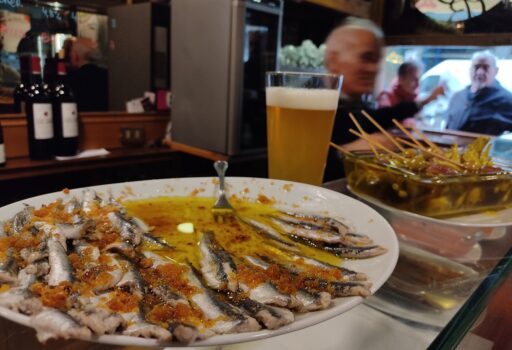
In San Sebastian, some bars keep alive the socialising culture of the pintxo that we love so much. This is a process in which the bar is the main protagonist, the hosts are as important as the food, and the dishes are always home-made. Family businesses that have been running for several generations, where the human treatment of the customer is above all else, and is always the responsibility of the owners, who are behind the bar or in the kitchen.
Because only when you visit these bars with their own personality can you truly understand Basque culture in general, and the culture of San Sebastian in particular, we have compiled some of our favourite bars in this post. Ten family bars that have remained faithful to their roots, that safeguard the Basque gastronomic tradition, and where the proposal, both culinary and human, is identity-based.
Traditional bars in San Sebastian’s Old Town
Tongue, at Haizea. Poteo, at the Etxebe. Traditional cuisine, at La Viña. And hospitality history, at the Intza. In these establishments of the Old Town, they welcome by their first names those who pass through the doors of their houses, and are the best hosts for the curious newcomers whose names they do not yet know.
We give the floor to the owners of these family businesses that offer homemade food in the Old Town of San Sebastian, so that they can explain the history and essence of their bars to you.
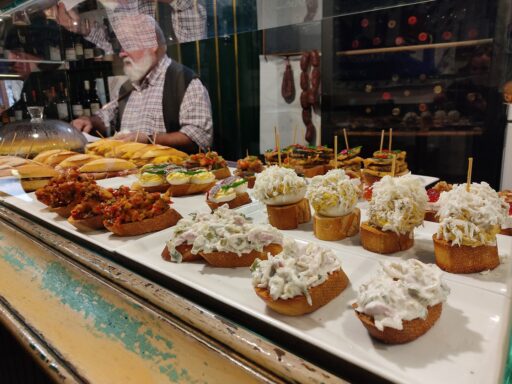
Pintxos in Bar Etxebe
The Intza, a restaurant with a long, long history
Asier Astrain “Everything that has happened in this bar, the family bond that underpins it, and the fact that lifelong people keep coming back is what fills me up the most”.
“The Carlists occupied the upper part of the restaurant, and every time the mistress hung up her clothes, she was fined.” “I grew up in a basket on the floor of the restaurant’s kitchen.” “In ‘37 they forced my great-grandmother to call it bar España, because at that time there was a lot of repression.” Koldo and Asier, third and fourth generation, respectively, of the Intza restaurant in Esterlines Street, speak. And listening to them offers a historical perspective not only on daily life in the Old Town of San Sebastian, but also an idea of the evolution of the hotel and catering business in recent decades.
This establishment, the oldest of the Old Town, was founded in 1933 by Paulina and Juan Antonio, a married couple from a farmhouse in Urnieta, and since then it has been handed down through each generation until Asier, now in charge of the business, is the great-grandson of the founders. This restaurant started out as a place for banquets, with two elegant dining rooms. A different personality to that of today, but still evident through those old photos that cover the walls of the bar and dining room, and show what the same place was like in the middle of the century.
Anything that has remained intact over the years? That familiar and close treatment, so familiar in the past, with which they serve the baby squid in its own ink, the pig’s trotters, the tortilla pintxos, the mixed dishes, or the sandwiches, all of them home-made. Also the family roots: mother, father, son, aunt, and several employees, who are as much a family as the rest, work side by side. And they all do so under the watchful eye of the eldest, who at 78 years of age, now retired, comes to eat at Intza every day. Because, “even if she says no”, her grandson Asier confesses with a smile, “Koro is still in control”.
Open from Wednesday to Sunday, from 11.30 to 15.30 and from 19.00 to 22.30.
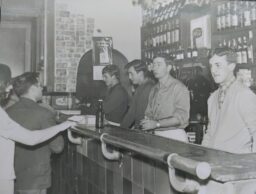
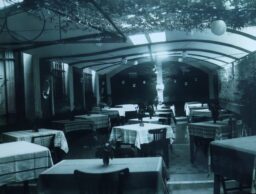
Historical photos of Intza
La Viña, much more than the most famous cheesecake on the planet
Santi Rivera: “We can’t stop being a pintxo bar and a traditional Basque restaurant, because that is our identity.”
The history of La Viña dates back to 1965. At that time, few businesses were being set up in the Old Town of San Sebastian, and the product most sold by the innkeepers was wine. The fishermen knocked on the door of the bars, arriving with freshly caught anchovies and sardines, looking for someone to cook them for them. During those years, and just as the grills of Getaria also emerged at the same time, in La Viña they prepared the fish for them in order to do business with the wine that they sold to the fishermen during the meal.
Santi Rivera, second generation of La Viña, remembers it. In those early days he recalls, in charge of the restaurant: his father, his uncle, his aunt and his mother. His mother: Carmen Jimenez, as can be read above the kitchen arch. “I bought this place”, Santi declares, “but the restaurant was founded by my parents, and my mother’s name presides over the kitchen because of the effort she always passed on to us”.
He joined the family business at the age of 27, and quickly realised that serving was not enough, so he immediately took an interest in cooking, and innovated part of the gastronomic proposal. The cheese and anchovy canutillo and the famous cheesecake are his work. He recalled how his father had predicted the success of San Sebastián’s most representative cake at the time.
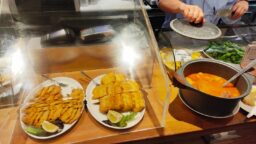
However, the worldwide boom in this dessert has not undermined the origins of La Viña. Because although the cheese dessert is recognisable all over the world, it is the hake and anchovies in batter, the meatball casserole or the guindillas in season that dominate the counter. “We keep this model of home-made cuisine and innovate as much as we can. We have a reasonable price with good food, cooked from a classic point of view, and sometimes we do some innovation…”, Santi describes the essence of the restaurant. He reflects for a while and adds: “It has taken a lot of effort, but it is the effort that my parents taught me; and in general terms there has been more sunshine than clouds”.
More than five decades after its opening, at La Viña’s bar and in its dining room, customers sit at the bar to enjoy pintxos and dishes as they used to: homemade products, while chatting with the locals and the diners around them. Among them, the two current owners: Santi, son of the founders, and Mikel Castellanos, an employee of the house for the last 30 years.
Opening times
From Tuesday to Sunday from 10.30 to 16.00 and from 19.00 to 23.00.
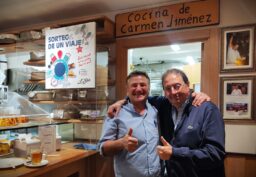
Santi Rivera and Mikel Castellano
Counter of La Viña
Bar Etxebe, an obligatory stop on the poteo route
Heliodoro Etxebe: “This is more than a bar, it’s a club of friends”.
Because Iñigo Street is not such a busy street, or because from the outside the glass door does not allow you to sense the magic that reigns inside, if you have passed in front of the Etxebe, it has probably not caught your attention. Now, if you’ve ever been inside, you know it’s one of those places you’ll come back to time and time again.
Because few restaurateurs enjoy the authenticity of Mr. Heliodoro; because the rich drinks go down much better when accompanied by the delicious tapitas prepared by Arantxa; and because the regularity of its fixed clientele from San Sebastian conveys an unparalleled sense of belonging.
It is a mythical temple of poteo, and its offer is that of a snack to accompany it. Sausages; marinated anchovies; gildas; loin of daggerboard, Iberian pork loin, and red tuna from Barbate in oil; potato omelette, cold pintxos with mayonnaise; and battered anchovies. That today, because in its origins, back in 1983, it was a restaurant for 80 diners. Due to problems with the live show (those classic ‘80s Boulevard ballads that didn’t allow customers to get to the previously reserved tables), they moved to the night and the nightclubs reigned supreme. Until, age dictates, the midday and evening poteo prevails today.
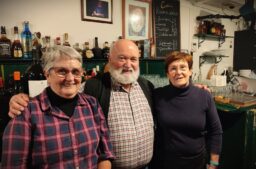
The cuisine: product-based, with time and love. And the service: professional (Helio has been behind the bar for 62 years, which is soon to say), familiar, and fun; above all, fun. The counter sometimes looks like a meeting room whose officiant orchestrates the conversations back and forth. If you haven’t witnessed one yet, be sure to go soon because the couple and sister-in-law Carmen, the three architects of the magic of Etxebe, are looking forward to a rest and, unfortunately for us, those improvised aperitifs won’t last forever.
Opening times
Wednesday to Saturday from 12.30 to 15.30 and from 18.30 to 22.30
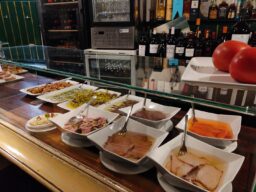
Counter of Bar Etxebe
Heliodoro Etxebe, Arantxa and Carmen
The Haizea and its traditional cuisine
Maite Agote: “We do everything at home: we don’t buy anything commercialised”.
Haizea is one of the few bars in San Sebastian where you can order a breaded tongue sandwich. It is also one of the only places where you can taste homemade callos (tripe), but really homemade. The kind that starts with the whole tripe, to clean it, cut it, boil it and stew it until it becomes tripe with its own personality. Because in this bar, on the corner of Aldamar Street and General Echagüe Street, the recipes of yesteryear prevail, and the parts of the cow and pig that are most in disuse nowadays continue to play a leading role in this windy corner of the city.
“The more modern the cuisine has become, the more we have opted for the traditional and the old. We would have taken things out, but the customers have not allowed us to do so, so we have had to extend the menu to include new things”, argues Maite Agote. She opened this establishment with her husband Mitxel Ibañez, and her brother Iñaki Agote, on the first of August 1992, and has been building customer loyalty for more than three decades.
The new proposals are the cod brick, the scallop and prawn brochette, or the duck tenderloin. Culinary innovations, made possible thanks to the collaboration of his nephew, Iker Agote, chef at the Matteo restaurant. But in one thing they have not allowed themselves to modernise: the treatment of the product. “We do everything at home: even the bell peppers are roasted here. And this procedure takes a lot of work, but it guarantees quality”, Maite emphasises.
Opening hours
Monday to Saturday from 7.30 am to 3.30 pm and from 7.00 pm to 11.00 pm.
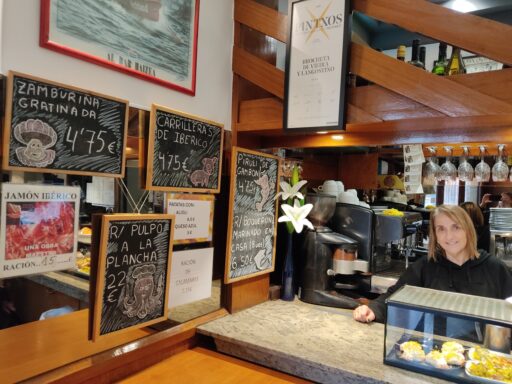
Maite Agote
Traditional bars in the Gros district of San Sebastian
While dozens of new bars have opened in the Zurriola beach neighbourhood in the last decade, as a result of the boom in gastronomic tourism in the city, the traditional businesses and their specialities continue to set the socialising course of the neighbourhood. Ioseba, Gorka and Iñigo talk about how they revitalise their bars, which have lasted for several generations.
Txofre Taberna, or how the house speciality has transcended for decades
Ioseba Balda: “Our traditional proposal is not wrong, because both young and old like the traditional”.
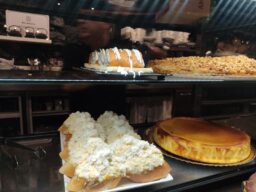
The Txofre Taberna on Gloria Street, formerly Ezkurra on Calle Miracruz, is proof of how a strong commitment to the house speciality, and staying true to its recipe, can transcend three generations. Because although it is true that there is a wide range on offer, the queen and the unrivalled attraction is still the Russian salad.
The tortilla de patata (potato omelette) is also a powerful stimulus at this point, and any of its traditional dishes, always home-made, can delight demanding diners. But if you ask three generations of the same family from San Sebastian where they go to eat ensaladilla, grandparents, parents and children all answer in unison that they go to Ezkurra (the children will soon say Txofre).
“What we like is what is good and recognisable”, says Ioseba without batting an eyelid. He is the third generation of the Ezkurra family. His family took over the classic restaurant in Mirakruz kalea in 1960, and grandparents, fathers, mothers, uncles and aunts worked together in the business. They quickly became one of the top restaurants in San Sebastian with their ensaladilla rusa, and they haven’t left it since then.
Ioseba does not know when he learned the trade, because the bars have always been there, he admits. And since 2002 he has been running the business (first with his brother, now on his own), and he remains faithful to the recipes of yesteryear. Rations of squid, tripe, blood sausage, chicken wings or cod ajoarriero. There are also real hamburgers, generous sandwiches and mixed dishes. And of course, the classic cold pintxos at the bar.
The biggest innovation has come with the change of premises. Why move to a new location? “To make it more comfortable for customers and employees. Here the kitchen and dining rooms are more spacious, and we also have a large terrace on a pedestrian street. Of course, we are only a few metres away from the old bar, because changing environment has never been an option for me”, argues the owner.
The curious thing about the new space? That 65 years ago his whole family moved to San Sebastian from a farmhouse in Betelu (Navarra) because a brother of his aitona gave them a tip-off that the Ezkurra was being transferred. And, surprise surprise, what bar did Antonio Balda who tipped off the family run? The Bodegón Gloria, located in the same space where Ioseba is now continuing a family tradition in Donostia that has transcended in Donostia like few others.
Opening hours
Tuesday to Saturday from 11.00 to 16.00 and from 19.00 to 24.00, Sundays from 11.00 to 16.00.
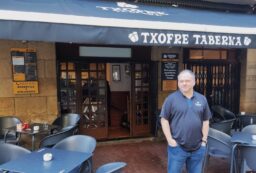
Ioseba Balda
Counter of the formerly Bar Ezkurra
The Desy, and the pintxo in beer key par excellence
Gorka Ávila: “It’s a traditional pintxo bar, only the owner likes beer”.
Six craft beer taps. Two fixed taps for the local brews Basqueland and Gross, and four rotating taps, where the offerings alternate freely. The quality and diversity of the hop drinks is the focus of this legendary bar on Ronda Street, whose parishioners block the pavement at drinking time. But there’s more; because the homemade raciones and pintxos, the socialising human touch of the bar, and the uninterrupted kitchen opening hours (you can eat from 11.30 am to 10.30 pm) are its other three main pillars.
“We like people to participate, and we like them to come to the bar because we don’t want to lose the contact and the spark of the traditional Donostian catering“, says Gorka, explaining how the socialisation implicit in Basque gastronomy is indispensable in the service at Desy. He is the second generation of the legendary Gros bar: son of Desideria, who gives her name to the bar and until recently was in charge of the kitchen, and José Mari, still behind the bar. The couple founded the bar in 1986, when Gorka was barely ten years old, and the boy has been learning about cooking and catering since his early childhood. He has worked side by side with his parents all his life, and ten years ago he took the reins.
Since then, the menu has not undergone major changes. They continue to build customer loyalty with their marinated anchovies on toast with grated tomato and oil, Desy mushrooms, txuleta burgers with cream cheese, meatballs, or the classic Desy potatoes. Dishes that have reached a new foreign clientele as a result of their repercussion in networks, and that, in Desy, are treated with the same familiarity as those who have been there all their lives. “I like foreigners to have the same opportunity as we do, and I make an effort to make those who are far from home feel like one of us”, he says about this friendly and hospitable treatment that is as distinctive, if not more so, of Desy, as his craft beers from cañero.
Opening hours
Monday to Saturday from 7.00 am to 11.00 pm
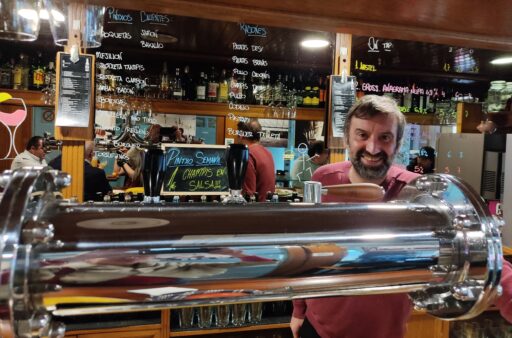
Gorka Ávila
Bar Rikardo: the most classic aperitif in Gros
Iñigo Marín: “This type of business is dying out”.
Bar Rikardo is one of those bars that enhances the aperitif ceremony, just like in the old days. Drinks are the king; the homemade fried food, the temptation you can’t resist; and the bar, the main protagonist, from where Iñigo and his team energise the midday atmosphere. It is probably for all these reasons that this bar on General Arteche Street is the classic par excellence of the poteo grosero.
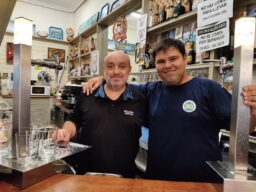
The Rikardo has been building up customer loyalty since 1974, when the parents of the current owner, Iñigo Marín, took over the bar. By then it was already called Rikardo, after the previous owner, and since then the house fried food has been the great speciality. Croquettes, mussels, calamari, stuffed peppers and prawns are now part of the neighbourhood’s heritage. Also its meatballs and battered anchovies. “Because we are one of the few who make things here“, says Iñigo. And he adds: “In Gros there are four of us who make croquetas at home”.
He has been running the business for 15 years, when his mother retired, although he had been working with his parents for ten years, and since then he has strived to preserve the identity that the bar had in his parents time. “For my part, I’ve limited myself to giving it a facelift while maintaining the essence of a traditional bar,” he describes the atmosphere that fills you as soon as you walk through the door. The TV: on. The customers: leaning on the counter or occupying those tables full of cider glasses filled to the brim with Keler beer. And the conversations between staff and diners, everywhere.
Opening times
Thursday to Tuesday from 10.00 am to 11.00 pm
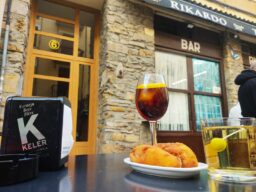
Croquetas of the Bar Rikardo
Iñigo Marín and his team
Traditional bars in the Centre of San Sebastian
In the centre of the city, one of the most emblematic dishes in town. From Easo Street, Jon continues to perpetuate the fame of the Platillo de Patatas. But not only. Because in this district of San Sebastian we can also find a traditional bar, and its owner, Juan, gives us an idea of how the hotel and catering business worked 50 years ago.
Bar Ciaboga, potatoes with confidentiality contract
Jon Enrique: “The recipe for our potatoes did not come from this bar”.
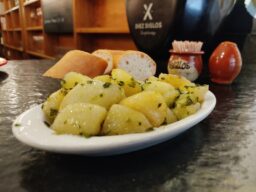
Ciaboga is proof of how a lot can be done with very little. Because with the most basic foodstuff they have created not one delicacy, but several. Potato, potato and more potato: that is the basis. And with that, the garlic potato dish, which is almost as famous as the La Concha Beach, and those varied omelettes, which are finding more and more lovers. Whoever thought that to delight the palate you needed exotic and expensive products was wrong, that’s for sure. And those who thought that the product alone was enough were also wrong, of course. Because Ciaboga potatoes have a lot of secrets.
“This recipe has not left the bar, and everyone who comes to work here signs a confidentiality contract. This is the only way we can protect our essence, because these potatoes have only been made here”, explains Jon Enrique, the current owner.
The legendary recipe precedes it and dates back to 1964. The work of Bautis and Carmen, the couple who founded this legendary bar in Easo Street. Although the team that has given these potatoes the greatest projection has been the one made up of the partners José and Carlos (Jon’s father), at the helm of Ciaboga for the last 33 years. Also Marijo, at the helm of the kitchen for the last 34 years.
The Ciaboga is a classic poteo in the centre of San Sebastian, and by now the varied potato omelettes and mushrooms with prawns are as famous as the dish. One with onion, another with caramelised onion and green pepper, another with knuckle of pork with cured ham, one with four cheeses, one with mushrooms and ham and cheese, and even one with black pudding. They are now a classic for Semana Grande sandwiches or beach days, and their flavours attract a multitude of parishioners.
Opening hours
Wednesday to Saturday from 9.30am to 10.00pm, Sunday from 11.00am to 3.00pm and Monday from 9.30am to 10.00pm.
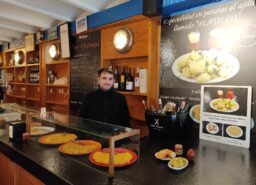
Jon Enrique
The potatoes of the Ciaboga
The Esnaola or the incomparable charm of neighbourhood bars
Juan Esnaola: “We are a classic, classic bar”.
This bar on Moraza Street is living proof of the daily life of a large part of the people of San Sebastian. One of those bars where you live rather than celebrate, and where it is evident that here, as in any other city on the planet, we Donostiarras are in a hurry during the week; of course, in San Sebastian, although fast, we want it delicious, homemade, and served with professionalism and humanity.
“The pintxito de tortilla, the bocatita de jamón, the raciones and the bocatas. What people are looking for on a day-to-day basis”. This is how the owner, Juan Esnaola, describes his proposal. He is the second generation of this classic Amara Viejo restaurant founded by his parents, Puri and Manuel, in 1970. Despite fifty years of history, the culinary proposal has remained quite faithful to its roots. Portions of rabas, tripe, octopus, or torreznos; sandwiches of various omelettes, cooked chorizo, vegetables or mixed; gildas; montaditos. Homemade gastronomy without frills, and above all, professionalism. Because Juan is an innkeeper through and through.
Attentive, dynamic and welcoming, he is one of those who dominates the room from behind the counter, even when his back is turned, and one of those who does not neglect a single detail. It is not in vain that he has been in this bar “all his life”, as he says. “What is now a warehouse used to be our house. That was commonplace 40 years ago… When I was a child, I used to be woken up by the noise of the bar: the coffee machine or the Txaranga”, he smiles. And nowadays, although he no longer lives there, in his bar room that family atmosphere is transmitted, where interaction between equals is inevitable.
Opening hours
Monday and Tuesday from 8.15am to 3pm, Wednesday and Thursday from 8.15am to 10pm, and Saturday and Sunday from 9am to 11.45pm.
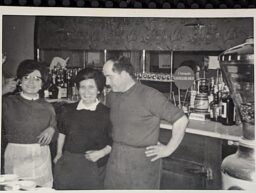
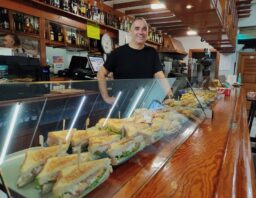
Historical photo of the Bar Esnaola
Juan Esnaola
Traditional bars in the Amara district of San Sebastian
If Amara, for those who are not from this neighbourhood, is the great unknown for a pintxo route, Egoki brings light to the art of good food from Avenida Felipe IV. It is an identity-based proposal like few others, which has not succumbed to the modernisation of its traditional dishes.
Bar Egoki, delicious cuisine in the Amara neighbourhood
Arkaitz Martínez: “Everything is homemade, and we go with the times”.
“The best meatballs: my mother’s!” These are recurrent statements among many people. Because it is very difficult for a stranger to devote the same care to cooking as someone else does when cooking for their own. And above and beyond affection: experience. The experience accumulated by those who have been in charge of the family kitchen for years is an excellence that is almost impossible to imitate, and therefore difficult to replicate in bars.
Well, at Egoki, the cliché of how it’s like nowhere else at home is disproved. Because the best meatballs: Lourdes’. And the best croquetas, too. It’s not for nothing that in mid-December the kitchen can’t cope because the regular customers are already ordering assortments of fried food to take home, freeze them and serve them at Christmas.
This bar on Avenida Felipe IV takes home-cooked food out into the street. From early in the morning, you can hear from the bar that chop chop chop of the casseroles already in progress in the adjoining kitchen. Could it be the baby squid in its ink, the tripe, the cheeks? Some of these homemade dishes prepared with time and a lot of skill, because by mid-morning the faithful customers are already flocking to the bar until the entrance is full at midday.
“Forty years cooking: imagine what a hand he has“, declares his son, Gorka. He is at the bar, where his father used to be, because Egoki has always been a family business. At first it was run by the couple. At that time, the son was working outside, but when his father retired, his mother suggested that he should join, he did not hesitate, and for the last eleven years, mother and son have been an unbeatable tandem. And as is typical of family businesses, not only the flavours are from home, but also the love with which the dishes are served.
Opening hours
Monday to Saturday from 8.00 a.m. to 3.00 p.m.
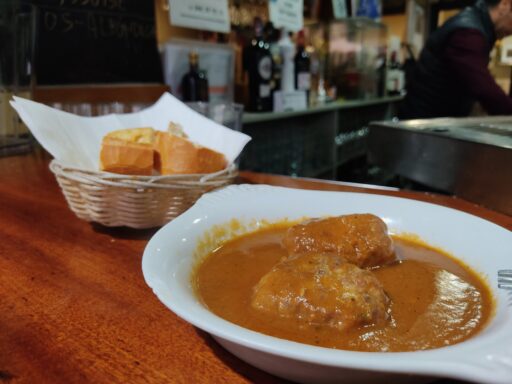
The meatballs of the Bar Egoki

Hegoi has been a local guide in Go Local San Sebastian for almost 10 years. A local among tourists, who loves his profession and enjoys showing his hometown. He also plays a key role in the teams of Free Walking Tour and Bike Rental.
Related tours
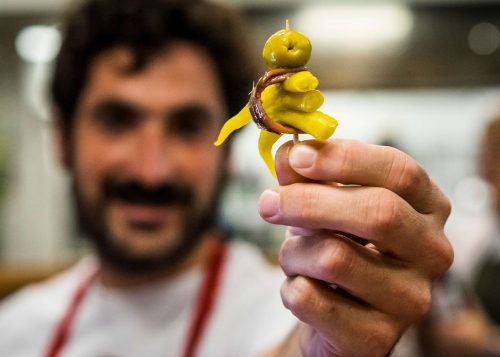
 Private Walking Tour
Private Pintxo Tour Old Town
Enjoy the experience of going out for pintxos in San Sebastian like a real local and take home an unforgettable souvenir of the best pintxos in San Sebastian.
- When Everyday**
- Hour 11:00am
- Duration 3 hrs
- Language/s Esp / Eus / Eng / Fran
- Price
*Minimum possible price per person, varies depending on the number of people on the tour. If you would like to know more, please do not hesitate to contact us.