Basilica of Saint Mary of Coro
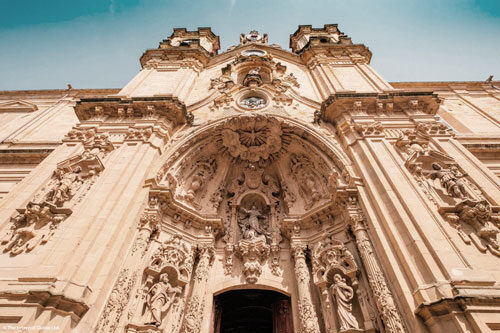
Strolling through the Old Town of San Sebastian, you are bound to have come across a couple of churches: Saint Vincent, in Gothic style, and Saint Mary, which we are going to talk about today. They are not the only churches in the city, of course, but they are the two most important ones, as they are also two of the oldest buildings in Donosti. And although we have a special fondness for Saint Vincent, Saint Mary is undoubtedly the church par excellence of our city.
Saint Mary of Coro
The church is officially called the Basilica of Santa María del Coro, although we all know it simply as Santa María, and together with Saint Sebastian, she is the patron saint of the city. Her feast day is 8 September, although it is not celebrated as much as that of Saint Sebastian.
History of the basilica
The history of Saint Mary begins in the 12th and 13th centuries, when the first church was built on this site located at the intersection of Calle Mayor and Calle 31 de Agosto. This first church was commissioned by the kings of Navarre when the city of San Sebastian was founded. It was built in the Romanesque style, and as far as we know, nothing remains of it in the current building.
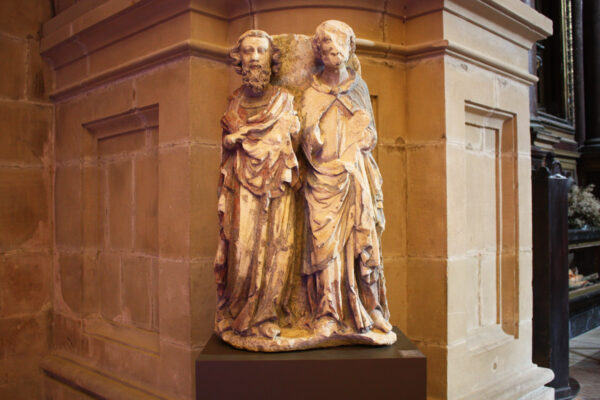
Sculptures of Saint Peter and Saint Paul from the Gothic church. Photo by D’Museoa.
Later, in the 16th century, this ancient Romanesque church was enlarged by the Habsburgs in the Gothic Renaissance style (the same style as the Convent of San Telmo), whose layout and orientation we still preserve today. Unfortunately, this building was severely damaged in 1688 when a powder magazine located just behind the church exploded, destroying much of the monument. Thus, in the 18th century, a major reconstruction was carried out, this time in the Baroque style, which was completed in 1774 and financed by the Royal Guipuzcoan Company of Caracas.
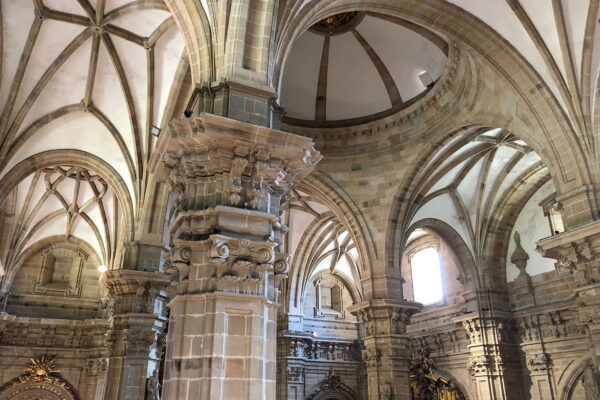
Detail of the interior. Photo by D’Museoa.
The church we see today is the same one, preserved almost intact after all this time. During the siege and subsequent attack by the Anglo-Portuguese army in 1813, the building survived, as did the entire Calle 31 de Agosto, which was renamed precisely because of this event.
The building
Saint Mary is a hall church, typical of the Basque Country, divided into three naves, with the main entrance on one side, so that when you enter, you find the altar on the right and the choir on the left. With high ceilings, as it is close to Mount Urgull, its few windows are located at the top of the building, which means it can be quite dark, especially in winter. The old chapels now house the diocesan museum.
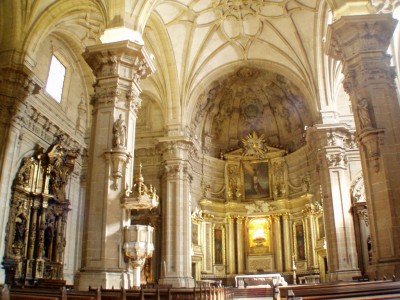
Interior. Photo by sansebastian.travel
Despite being a Baroque building, there is very little ornamentation inside, with the exception of the altarpieces and a few sculptures. It is a generally sober building when compared to others of the period, although we must not forget that its interior was once covered in silver and gold, stolen by Anglo-Portuguese troops in 1813. We can therefore imagine that until then its interior did resemble that of other churches of the same style and that its ornate decoration was a fine example of the Baroque.
On the outside, the Baroque, or rather Rococo, style can be seen on the main entrance. Profusely decorated, it shows the Assumption of the Virgin, with Saint Sebastian at the top and the city’s coat of arms crowning the façade. It is a Churrigueresque Baroque style that is concentrated on the entrance, leaving the rest of the façade clean and sober, more neoclassical than Baroque, something that we could say appeals to the sobriety of the Basques.
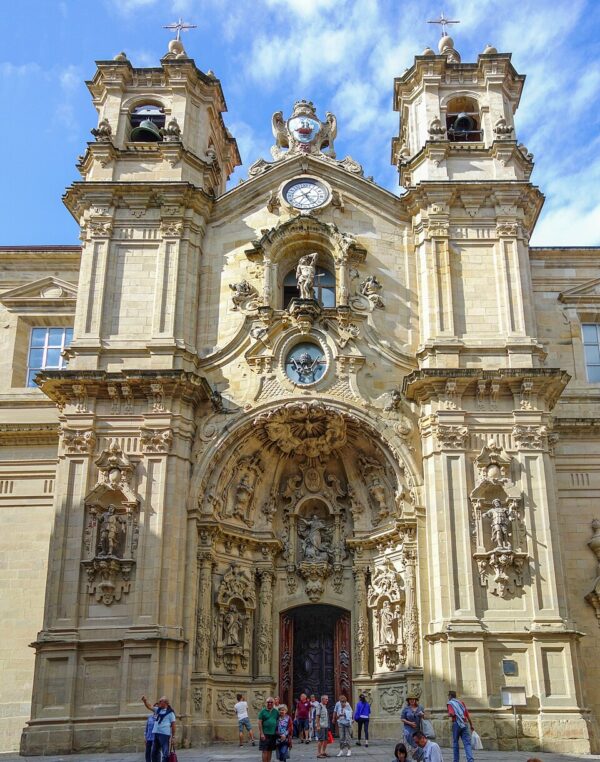
Main entrance. Photo from Wikipedia.
A triangle in the city
Speaking of Calle 31 de Agosto, at the end of this street is the Church of San Vicente, another survivor of the fire that ravaged the city in 1813. Both buildings face each other sideways, always watching over each other, a good representation of what life was like in that walled San Sebastian, where the poor belonged to the parish of Saint Vincent and the rich to that of Saint Mary.
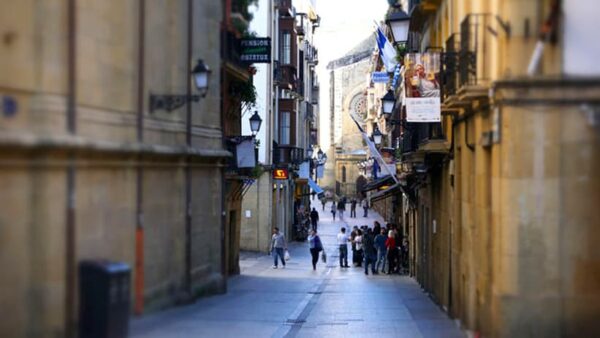
Saint Vincent seen from Saint Mary. Photo by Hay que ver.
But opposite our protagonist is another church, the Cathedral of the Good Shepherd. Built in the neo-Gothic style and inaugurated in 1897, it was constructed in the new San Sebastian that grew up after the demolition of the city walls. Located a thousand yards (835 metres) from Saint Mary, the new San Sebastian and the old one face each other, symbolising the union of both parts of the city.
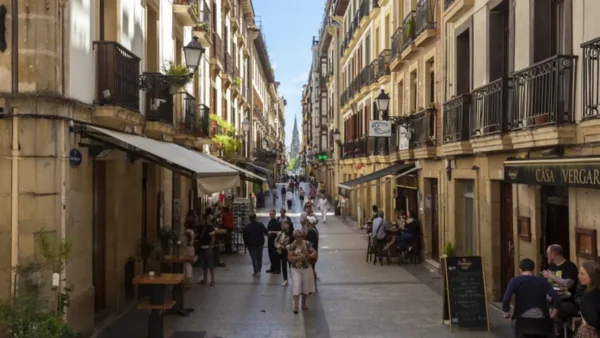
The Good Shepherd seen from Saint Mary. Photo by Crónica Vasca.
Thus, with Saint Mary as the centre point, we have a triangle of Catholic churches in Donostia, monuments that we encourage you to visit, as each one, in its own way, is important to the city and tells us about its history, architecture and customs. And although the three belong to very different artistic styles, they all have something in common: the sandstone brought from the quarries of Igeldo and Ulia, which gives San Sebastian its characteristic yellowish colour.

Hegoi has been a local guide in Go Local San Sebastian for almost 10 years. A local among tourists, who loves his profession and enjoys showing his hometown. He also plays a key role in the teams of Free Walking Tour and Bike Rental.