Santa Catalina Bridge
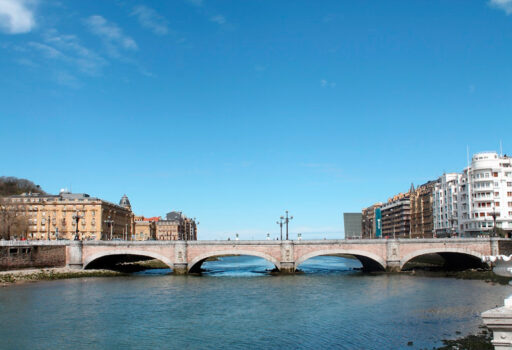
Today, the Urumea River, which divides the city in two, is crossed by several bridges from different periods and styles that help to easily connect the two parts of San Sebastian. In the past, however, there was only one bridge, the only way to reach Donosti from the east: the Santa Catalina Bridge. But with the city’s growth in the 19th century, it became necessary to make it easier to get here, which is why that original bridge is no longer alone, although today we will focus on it.
The origin of Santa Catalina
The first recorded Santa Catalina Bridge dates back to the 14th century and was made of wood. Before it was built, a ford was used to cross the river, which was barely deep depending on the tide. That bridge crossed from the sandy area of what is now the Gros neighbourhood to the marshes on the other side, near the current María Cristina hotel. On this side of the river stood a small church dedicated to Santa Catalina (Saint Catherine), which was surrounded by a few farmhouses, hence the name of the bridge (and that small neighbourhood).
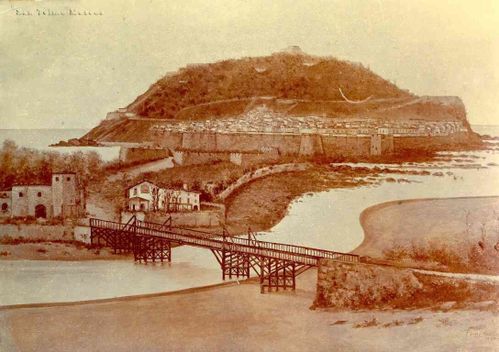
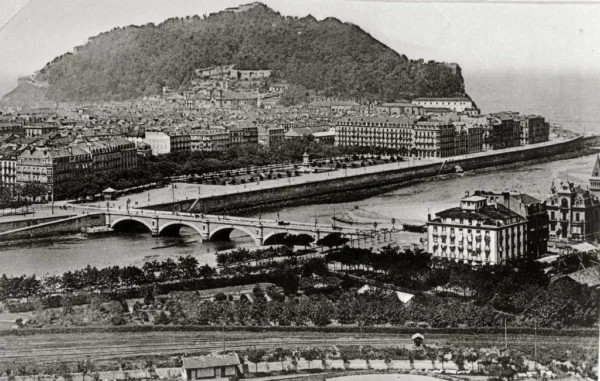
One of the many Santa Catalina bridges from the 19th century.
Obviously, nothing remains of this bridge, as it was made of wood so that it could be easily destroyed (and rebuilt) in the event of war or enemy invasion. Thus, storms, waves and the aforementioned wars have meant that we have had dozens of bridges in the same place over the centuries, although they have all had the same name. The last wooden bridge was demolished in 1874, coexisting with the current stone bridge for two years.
These wooden bridges, in addition to not being very sturdy, had to be crossed after paying a toll, which cost money to the residents of San Sebastian and visitors who had to cross it for different reasons, but which was necessary for its maintenance. Furthermore, having to rebuild it every so often (in the 19th century alone, it had to be done seven times due to the many wars of that period) was a considerable expense for the city, so building a sturdy stone bridge without tolls had long been a desire of San Sebastian.
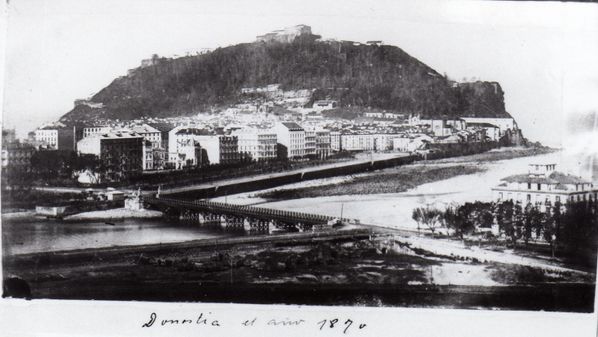
The last wooden bridge. According to sources, it was painted the colour of bull’s blood.
The new bridge
Finally, after years of requesting permission to build a stone bridge, this became possible in the second half of the 19th century, when Donosti ceased to be a stronghold in 1863 and the obligation to have a wooden bridge disappeared (similarly, it was not permitted to construct stone buildings, so that they could be easily destroyed in the event of armed conflict, which was a problem when it came to building the new extensions to the city once the walls had been demolished).
Thus, the new Santa Catalina bridge was built next to the old one, both leading to the same point in the centre, on Avenida de la Libertad, but starting at different locations, as the wooden bridge came from Iztueta Street and the stone bridge from Miracruz Street (still undeveloped at the time). Although the wooden bridge was demolished in 1874, as we have already mentioned, its piles can still be seen during spring tides, when the level of the Urumea River drops to almost reveal the sand at the bottom.
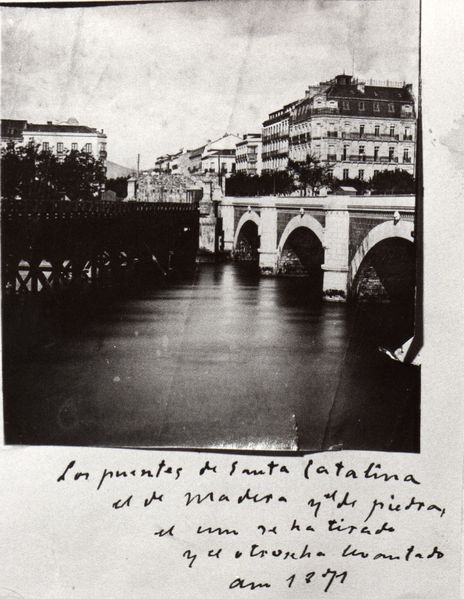
Photo from 1871 showing both bridges.
The stone bridge was inaugurated in 1872 and was originally narrower and longer than the current bridge, as it had five arches. With its simple lines and minimal decoration, it facilitated traffic from the east to the centre and the Old Town, both for carriages and pedestrians, and without tolls (these were eliminated in 1869 while the wooden bridge was still in use). Stones of different origins and colours were used in its construction, and the little decoration we can see is in the large lampposts at the corners, which display the coats of arms of Gipuzkoa and San Sebastian and were recently restored.
Today it only has four arches and is much wider because, on the one hand, when the Gros sandbank was developed, the Urumea was channelled and narrowed, making the fifth arch unnecessary; and on the other hand, because road traffic increased and it became necessary to add metres to both sides of the bridge to make more lanes. And this is the Santa Catalina Bridge that we see today and that the people of San Sebastian cross every day. It may not be the prettiest or the most modern, but it is the first, and that also counts.
The new bridge standing alone over the River Urumea.

Hegoi has been a local guide in Go Local San Sebastian for almost 10 years. A local among tourists, who loves his profession and enjoys showing his hometown. He also plays a key role in the teams of Free Walking Tour and Bike Rental.