Kursaal
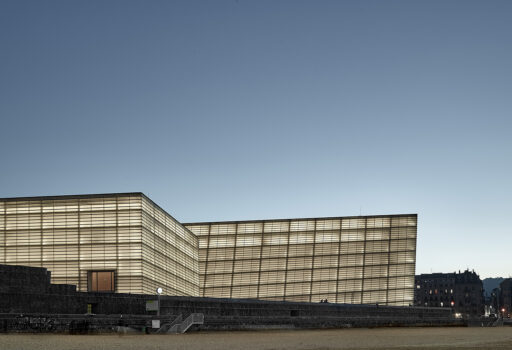
Architecture is one of San Sebastian’s main attractions. The stately buildings in the city centre are admired by everyone, as are its main churches and palaces. But Donostia is more than just its historic architecture. In recent years, modern buildings have been constructed in keeping with contemporary styles, the most notable of which is undoubtedly the Kursaal.
The Kursaal, officially known as the Kursaal Conference Centre and Auditorium, was inaugurated in 1999 and was designed by Rafael Moneo, which is why many people also refer to the building as ‘Moneo’s cubes’. Some people also call it ‘the Kursaal cubes’, but most of us simply say Kursaal.
It consists of two glass cubes, hence the name, which enclose the auditoriums of the conference centre. Beneath the cubes are multi-purpose rooms, shops, an exhibition hall and a restaurant. Behind, next to the beach, are terraces and, on a lower level, a car park. In short, the building has everything.
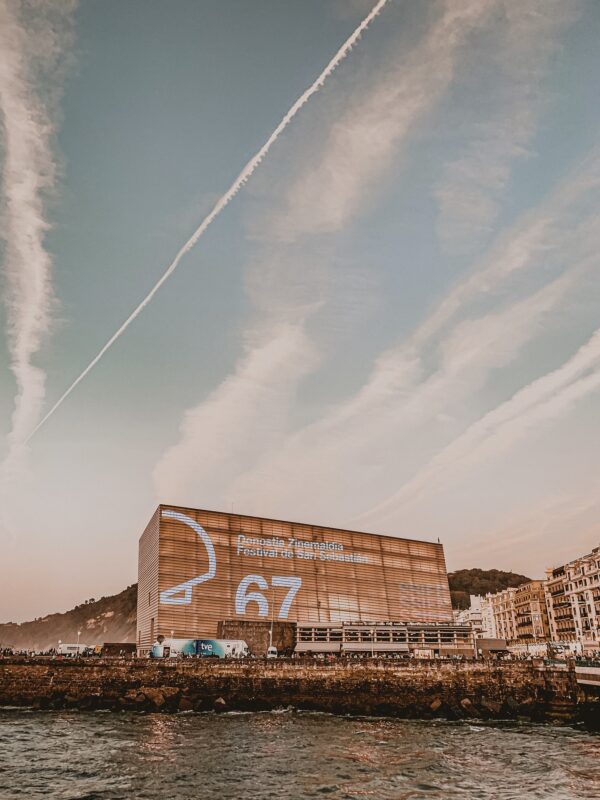
The Kursaal decorated for the International Film Festival.
But above all, it is the most important auditorium in San Sebastian. In fact, it is the main venue for the International Film Festival and the Basque Symphonic Orchestra. Congresses and conferences, stand-up comedy shows, concerts, musicals and operas are held here. There are also dance shows, fairs and even exams. There is not a single day without an event scheduled, so it is always a good idea to check the agenda to see if there is anything that interests you.
The cubes, on the other hand, resemble two rocks stranded on the beach, as if the rocks of the breakwater that protects La Zurriola beach had been pushed by the sea into a new position. Therefore, the Kursaal is only an extension of the breakwater, where we see other rocks fallen on the sand, reflecting the building.
The origin of the name Kursaal
But where does this name come from? It is clearly neither Spanish nor Basque; in fact, it is German and means “cure hall”. The “cure hall” or “kursaal” was the name given to a typical building in 19th-century spas in Germany, Belgium and the Netherlands, which usually housed a large entrance hall, a ballroom, a theatre and restaurants, among other facilities. In short, it was a multi-purpose building and the centre of social life in these spas.
Thus, the word ‘kursaal’ travelled throughout Europe to refer to these buildings with different uses that were built at the time in summer resorts and which could be found in San Sebastian, but also in Gijón, Manresa and Elche.
The Great Maritime Kursaal
Here in Donostia, this casino was inaugurated in 1921. After gambling was banned in 1924, it was transformed into a multi-purpose space, like any good Kursaal. It was an eclectic and historicist building, like most of the buildings in the city at the time. It was located on the same site as the current conference centre, which is why, when the modern building was constructed, it was given the same name as its predecessor, as a reminder and tribute.
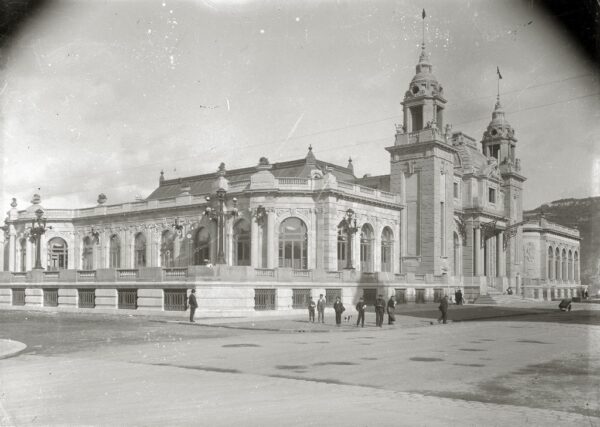
Former Great Maritime Kursaal.
The old Kursaal was demolished in 1973 after decades of poor use that had left it almost in ruins. The controversy was widely publicised, as it was a very beautiful building that the people of San Sebastian were particularly fond of. Even so, the controversy when the new Kursaal was built was even greater, because comparisons are odious, but also because the people of San Sebastian have very classic tastes. The new building was too modern, too big. It was a monstrosity next to La Zurriola beach that blocked the view of the neighbours. The ‘ice cubes’ were an eyesore and had no place there.
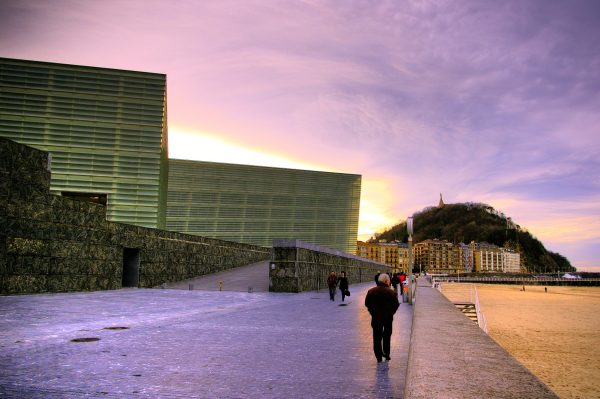
The Kursaal from La Zurriola promenade.
Needless to say, we have grown accustomed to the new Kursaal. More than 25 years have passed since it was inaugurated. We have grown fond of it, especially when it is lit up in white at night, or with different motifs on special occasions, such as Christmas. Furthermore, it is a building in constant use that has become well integrated into the cultural life of San Sebastian.
And inside it is beautiful, the auditoriums are lined with wood, its spacious hall has fantastic sea views and is full of light. The seats are comfortable, and it is easy to move around. Its terrace is an unbeatable place to enjoy the waves of the Cantabrian Sea. It took some time, but the Kursaal is now part of San Sebastian, and if it were suddenly demolished, we would surely miss it.
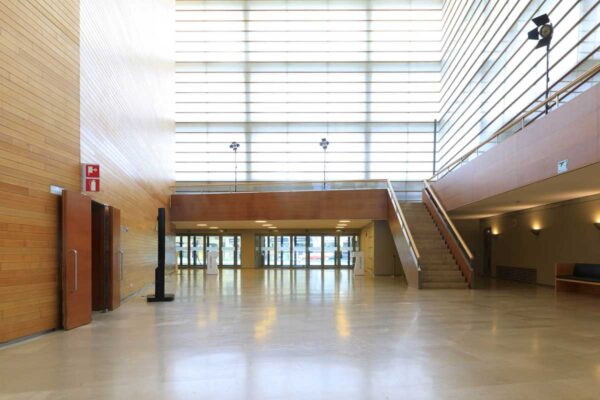
The large entrance hall of the big cube.

Hegoi has been a local guide in Go Local San Sebastian for almost 10 years. A local among tourists, who loves his profession and enjoys showing his hometown. He also plays a key role in the teams of Free Walking Tour and Bike Rental.