Those novels and films that whisper to us the soul of San Sebastián
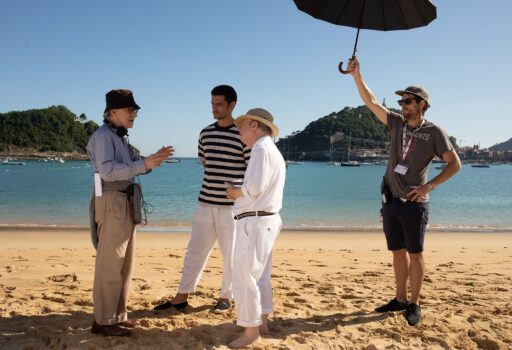
San Sebastian has been a source of inspiration for literature and film on numerous occasions. In some cases, the city and its surrounding towns are merely the setting for the lives and conflicts of the characters. In some others, Donostia and its most emblematic places are so important that they end up becoming just another character in the fiction.
Patria, Twist, Embarazados or La infiltrada allow us to get to know places in the city through words and images. They also delve into aspects of its recent history, which suggest why the city is the way it is, and contextualise the character of those who inhabit it. In this post we bring together some of our favourite books, films and series, those novels and films that whisper to us the soul of San Sebastian, where San Sebastian is at the centre of the plot.
Literature: books set in San Sebastian
If you say literature and San Sebastián, Pío Baroja quickly springs to mind. We will also immediately think of Harkaitz Cano, Fernando Aramburu, Ramon Saizarbitoria, José María Mendiola, or Fernando Savater. Because these writers born in San Sebastian have left their mark on literature. Some of them have won awards such as the Nadal Prize, the Euskadi Prize for Literature, and even a seat in the Royal Academy of the Spanish Language.
But if we are looking for books whose pages breathe San Sebastian, reducing the list to works written by people from San Sebastian or Guipuzcoa is a great oversimplification. Because there have been, and there are, many storytellers born in other places, who have portrayed the city in their works. Alaine Aguirre, Raúl Guerra Garrido, Antonio Muñoz Molina or Laura Balagué Gea are some of these outsiders who have captured the essence of the city in their stories.
Chronicles, short stories, essays, crime novels, memoirs, poetry. There are many genres in which to quote San Sebastián on one page, and to reduce the wide literary range to five publications is a naïve exercise, but we wanted to start somewhere! If you get the itch, look up the bibliography of the writers mentioned above, because they will more than satisfy your desire to read San Sebastián.

Fernando Savater, winner of the LVII Planeta Prize. Source: Excélsior.
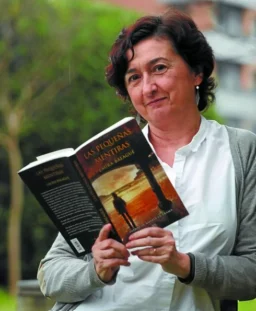
Laura Balagué Gea with her book "Las pequeñas mentiras". Source: El Diario Vasco.
El cementerio de los ingleses, by José María Mendiola Insausti
One of our favourite places in the city as a catalyst for the action. A mystery that unravels with each page, while transporting us to another era. And the alternation of several narrative voices with a brilliant naturalness to clarify the enigma. El cementerio de los ingleses is a literary gem by the prestigious José María Mendiola (San Sebastián, 1929-2003), who immerses us in the Old Town in the 1950s.
In this work, Mendiola strengthens our idyll with the English cemetery. Because the historical contributions on the motifs of the tombstones on the northern slope of Monte Urgull engage us with the space. Less than a hundred pages (it is a short novel) allow this writer, winner of the famous Nadal Prize in 1963, to alternate several narrative voices, delve into the motives of five characters, and keep the reader on tenterhooks from the very first line.
Two children, Pablo from San Sebastian and Virginia from England (visiting the city), try to clarify, in the purest detective style, the facts of the death of an English soldier who died in San Sebastian in unclear conditions 150 years earlier. Calle Mayor, Calle 31 de Agosto, Monte Urgull, the San Telmo Museum, the Basilica of San María del Coro, the port of Donostia, the Ayete neighbourhood and, of course, the English cemetery, are the settings where the suspense of the plot is fed. Spaces that we look at with new eyes after reading this book.
Cien metros, by Ramon Saizarbitoria
Cien metros (translated from the original Basque Ehun metro) is a work by the award-winning Ramon Saizarbitoria (San Sebastian, 1944), and is considered a key novel in Basque literature, and one of the foundational novels of modern Basque literature. Part of its greatness lies in the fact that this book allows us to understand in just 100 pages matters that would take more than 1,000 pages.
It tells the story of the police chase of a former ETA member through the Plaza de la Constitución: the last hundred metres before being shot. And with the chronicle of the frenetic race as the main thread, Saizarbitoria portrays an entire society. In doing so, he alternates a multitude of literary devices. He reproduces conversations between neighbours, describes in detail central places in San Sebastián, and takes news extracted from newspapers of the time. And all this, with constant time jumps to represent the society and the political and social climate of Donostia in different periods.
So much information does not hinder the reading – on the contrary, how does the author keep our attention? Thanks to an inescapable use of the second person singular that keeps us voraciously in the present. ‘Your chest hurts’; ‘You are drowning’; ‘Your father warned you one day’; ‘You clearly perceive the footsteps of those who are chasing you’. Thus we are constantly brought back to the police chase, and we keep running with the protagonist, each time with more historical context.
Ramon Saizarbitoria wrote Cien metros in 1972. It was not published until 1976, and that first edition was seized by the police following a complaint to the Public Order Court. Several years later, the novel was released into circulation.
Pasaia Blues, Harkaitz Cano
This novel by Harkaitz Cano (Lasarte, 1965) takes us into the port environment of the Bay of Pasajes in the 1990s. Docked merchant ships, mountains of scrap metal, dockers on strike, industrial pavilions housing unsuspected actions. Pasaia Blues smells of saltpetre, sounds of ship engines, and creaking trains on rails. It takes us away from the picture-postcard San Sebastian, and presents us with a marginal Pasaia, where several caged characters move about.
Policemen, ETA members and criminals unknowingly converge around the docks of Pasaia, where activities are taking place that we would never have imagined. One searches and observes. Others wait and hide. Some do and undo things without being seen. None of them are what they seem at first, and throughout the novel we discover the details of each one of them to get a complete picture at the end. And until then, we listen to the characters’ reasons: their fears, their stimuli, their failures.
The acclaimed writer of Twist (Euskadi Literature Prize) delves into violence and double-standard personalities through Marta, Olatz, Potemkin, Roberto and César. With the poetic language that characterises him, Cano argues the motives of his characters, and awakens the reader’s reflection. He tackles subjects such as police torture against ETA members, the motives behind the terrorists’ struggle, and the possibilities of escape from violence for all of them, approaching each character from a very human level. All this while whispering blues lyrics, and the constant flashing of the headlights of the cars on the N-1 at Pasajes Ancho.
Las pequeñas mentiras, by Laura Balagué Gea
An Ertzaintza inspector, a murder to be investigated, and a city to be traversed in search of evidence. Las pequeñas mentiras is a detective novel that one devours without wanting to, not so much because of the suspense of the investigations, but because of the familiarity of the characters’ way of life. Because this book is a sequence of scenes of lcostumbrist scenes in which any Donostian can fit in without wanting to, and that closeness envelops the reader from beginning to end.
Do without the bus and walk along the banks of the Urumea River when the day is sunny. Walking along the Paseo de La Concha when you have a dull head, to clear your mind with your gaze lost in the bay. To hate the fact that in Donostia the rain does not know how to fall from top to bottom, and always lashes us diagonally, leaving the protection of the umbrella out of play. Seek refuge in the smell emanating from the kitchen, where a member of the family is perched after a long day’s work. Weighing up whether we will be happier to buy a flat in Miraconcha or in the Port on the day we win the lottery.
The main protagonist, the inspector Carmen Arregui, relates to the city in a way that any Donostian will consider her own. And once Arregui opens the door to her home, her family and her office, she and her team lull us in without pause. Because beyond presenting us with the police investigations, these pages also make us participants in the inspector’s most routine and human conflicts: her relationship with her children, her work colleagues, her boss, her mother, her husband and her brother-in-law.
The excuse for inviting us to become part of her life is the murder of a high society woman from San Sebastian, and the interrogations of her close circle also serve to contrast the differences between the different social classes in the city. Laura Balagué (Barcelona, 1958) won the La Trama prize for this novel.
Fuegos con limón, by Fernando Aranburu
A young man from San Sebastian who wants to be a poet: Hilario. A narrative voice in the first person who shares his literary aspirations with an almost comical vehemence and seriousness. And a seventies San Sebastian where he pursues his dreams with his companions in misdeeds: the members of the surrealist literary movement Placa.
This work is inspired by the story of its writer, the famous Fernando Aranburu. It was his first novel, published in 1996, and in it he recounts his experience in the CLOC Group: a surrealist cultural movement, which he founded with two other writers from the city during his adolescence. Although it is a work of fiction, it is inspired by real events, and is therefore a unique opportunity to discover the awakening of this writer from San Sebastian who, decades later, has produced an extensive body of work that has travelled around the world and has been translated into more than thirty languages.
In addition, while the protagonists of the book stimulate the cultural life of the city, the narrator Hilario describes the place where he moves, and presents a San Sebastian that has already disappeared. He takes us to the outlying neighbourhood of Ibaeta of his childhood in the 1950s, where the city’s poorest families live and the children play in the unpaved streets, where orchards and trees alternate. He also shakes us up with the usual police brawls on the Boulevard in the late Franco era. And it embarks us on stormy voyages to Santa Clara Island.
Cinema: films and series set in San Sebastian
La Batalla de Inglaterra, Desiré, Frío sol de invierno, Todos estamos invitados or El Negociador. San Sebastian has been the main setting for films on numerous occasions. Because of the beauty of the incomparable setting; also, and so often, as a backdrop for stories about ETA terrorist acts.
Mount Igeldo, the streets of the Old Town, the Bay of La Concha or the Wind Comb. The Bay of Pasajes and its traditional boat between San Juan and San Pedro, the port of Getaria or Santa Clara Island. There are a multitude of films where we can find a familiar corner. There are also many cinematographic stories through which we can get to know the Guipúzcoa of other times, and delve into social issues that are alien to us.
Because San Sebastian is a city of cinema, we propose here five audiovisual productions to look at the territory we inhabit from a different perspective. Also to discover that unknown place you are going to visit soon.
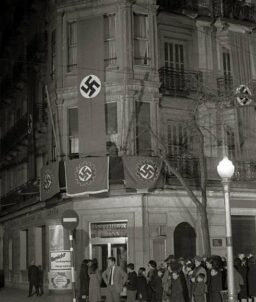
Filming of "El negociador". Source: Eitb.eus
Filming of "La batalla de Inglaterra". Source: El Diario Vasco.
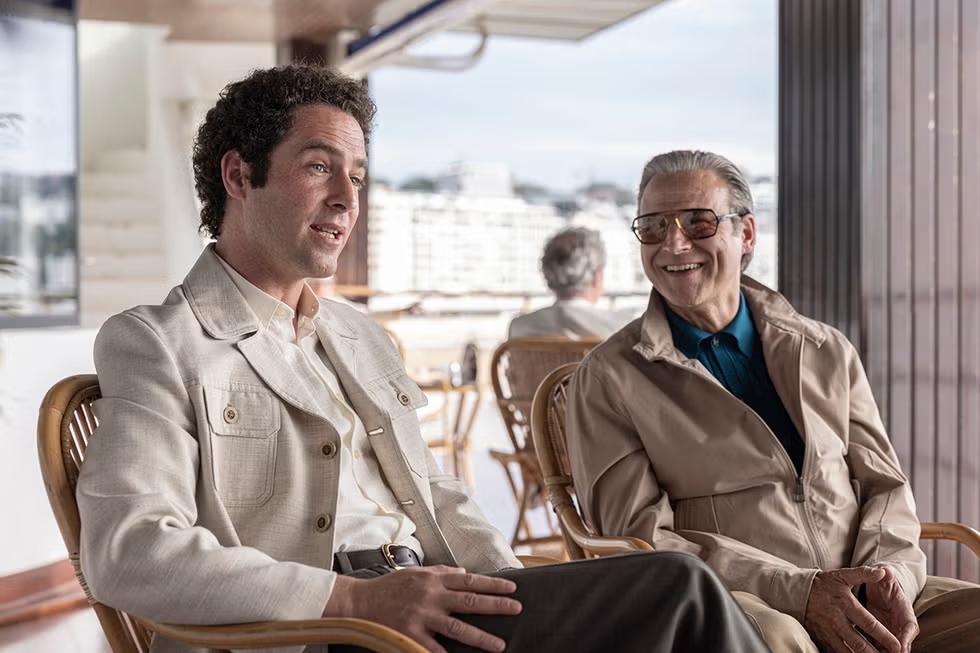
Balenciaga: a series with a historical perspective
An interview in the 1970s. The master of haute couture, Cristobal Balenciaga, agrees to answer questions about his life. ‘Well, this is my village, Prudence’, the couturier reveals to the journalist. From a car parked in the port of Getaria. While the rain hits the moon. And with that murmur in the background, the shot opens up to the historic centre of the fishing town in Gipuzkoa.
The settings for the conversation between the seamstress and the journalist are magical. The private terrace of the Náutico de San Sebastián, from where to lose sight of La Concha Bay and the port; the top of Monte Igueldo, from where to look out over the mouse of Getaria; and a port of Getaria, where the seamstresses still sew sitting on the floor, legs stretched out and wicker baskets at their side (an image difficult to find in the ports of Gipuzkoa nowadays).
From there, there are constant temporal and spatial jumps to Paris, Madrid and Getaria, as Balenciaga traces his career. Thus, this series reflects the social and political context of Francoism and Nazism in two countries (France and Spain); it presents the most influential French fashion designers of the last century (Coco Chanel, Hubert de Givenchy, Christian Dior), and portrays what life was like in Guipúzcoa in the last century.
French, Spanish and Basque alternate in this creation by Moriarti to convey the tension implicit in the border bridge of Bidasoa during Francoism. Also to stage the exile of the Spanish Republicans to France after the Civil War. And, of course, to delve into the deep family roots of Gipuzkoan families.
The series, available here, is devoured from minute one, thanks to the impressive and magnetic performance of Alberto San Juan.
Source: Fotogramas.es
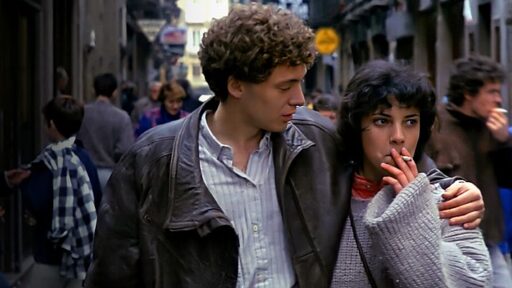
27 horas: the raw San Sebastian of the eighties
An old part paved with cobblestones. Streets populated by telephone booths. A city assaulted by police ballistic attacks. And a youth hooked on heroin. 27 hours is the perfect film to travel through the Donosti of the 80s. It is also an excuse to meet Maribel Verdú and Antonio Banderas when they were young. And, of course, a unique opportunity to do a memory exercise on how, several decades ago, the paperinas neutralised almost an entire generation in Euskal Herria.
This film, by Montxo Armendáriz, in whose script Elías Querejeta also participated, was released in 1986. It tells the story of three young friends with no great expectations for the future, and is set in a Donosti that has now disappeared. It is a city that is far removed from tourism, devoid of frills, and with a very identity-based feel. It was also a city where unemployment was plunging young people into precariousness, and where heroin was wreaking havoc among the young population.
Thanks to Patxi, we discovered a very different port in San Sebastian to the one we are visiting today. A dock where fishing boats dock, free of pleasure boats, and where fish carts are the main protagonists. With Jon we travel around the industrial bay of Pasajes by boat, in search of a day’s work unloading fish boats. And with him we also witness how heroin broke the unity of so many families in Gipuzkoa.
Lefties at the bar, pool tables and boat trips to the bay of La Concha to fish for baby squid. With these three friends we discovered not only a city that no longer exists, but also a leisure activity that is becoming extinct. And while we get to know all this, 27 hours go by, enough time in the 80s for heroin to claim two lives from the same gang.
Source: Rtve.es
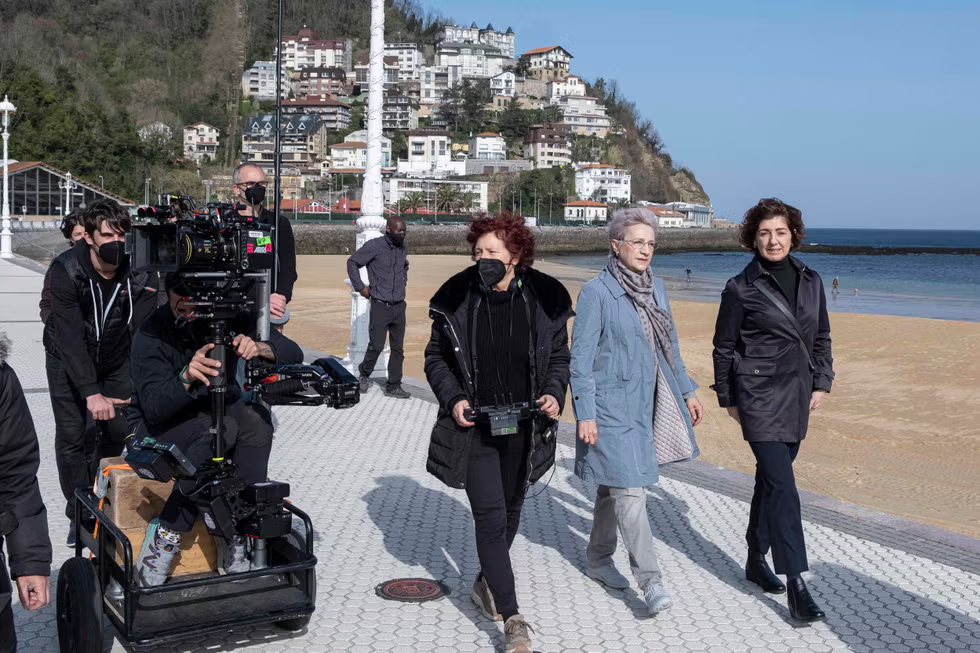
Maixabel, a transformative cinematic story
This film, by Iciar Bollain, is an overwhelming story. It is one of those stories that changes something inside you and that you will not forget for a long time. A narrative with a thousand nuances, which tackles from a very human perspective, a problem usually dealt with from a highly political point of view: ETA terrorism in the Basque Country.
This work of fiction, based on real events and written by Bollain and Isa Campos, tells the story of Maixabel Lasa. How the widow of Juan Mari Jáuregui, former Civil Governor of Guipúzcoa murdered in 2000, sat down in front of her husband’s murderers, the result of the Nanclares restorative meetings. Her motives for meeting them, the reactions among her family and friends, the assassins’ reasons for sitting down in front of the widow of the man they had killed. This script delves into the consequences of the violence in Euskadi for some and for others.
Because if Maixabel, played by a spectacular Blanca Portillo, who won the Goya for Best Actress for this role, is at the centre, her husband’s murderers, played by a convincing Luis Tosar and a brilliant Urko Rezabal, who won the Goya for Best Supporting Actor, also have great prominence. As does Maixabel’s daughter, played by María Cerezuela, winner of the Goya for Best New Actress for this film.
Seven minutes of uninterrupted applause from the audience at the San Sebastian International Film Festival after the screening of this film, including Maixabel Lasa, the real one. This film is a unique opportunity to remember history, to learn a lesson in empathy, and to relate to a very real Guipúzcoa through a highly artistic filter.
Source: Fotogramas.es
Rifkin´s festival: the most idyllic San Sebastian
If there is one film to fall in love with San Sebastian, it is Rifkin’s Festival, available here. Because never before has a film presented the city’s most endearing places with such charm. This film doesn’t miss a single one of the secrets of the incomparable setting. Of course, when framed and lit for a Woody Allen film, the lampposts on Paseo de La Concha or the kiosk on the Boulevard take on a new beauty, imperceptible to the eyes of the casual passer-by.
The film takes place during the San Sebastian International Film Festival, and is an opportunity to get to know the festival from the inside. To be part of the hustle and bustle of the Hotel María Cristina on those dates, to sneak into a private party, or to burst into those non-stop interviews held on the hotel’s terraces.
Encouragement after seeing the film? We want to live in Woody Allen’s San Sebastian. In that sunny, walkable San Sebastian in September. Starring in days during which we alternate intimate walks on the deserted ground floor of La Concha, with bowling in the Altxerri, private parties in the old church of the San Telmo Museum, meals at the Mirador de Ulia, and naps on the lawn of the Palacio de Aiete.
Those of us who live here know that a whole five years would not be enough time to get to know the idyllic city portrayed by Allen. It is impossible to walk along La Concha in the sunshine without a noisy crowd around you. It is unimaginable to visit that charming traditional market in the Plaza San Juan, which does not even exist. But dreaming is also worthwhile. And to fantasise about a divine San Sebastian, that of Woody Allen.

Source: Eitb.eus
Kalebegiak, twelve views of San Sebastian
Twelve short films. Several independent stories related to San Sebastian. And many scenarios of the city to discover Donostia through multiple characters. The traditional regattas of the La Concha Flag in September; the homeless people who do not appear in the tourist guides; the story of a victim of ETA terrorism; the meteorological problems faced by Basque coastal fishermen; the nightlife in the old part of San Sebastian; and even Queen Maria Cristina or Cristobal Balenciaga as a child.
These twelve short films deal with very different themes, always linked to San Sebastian. In fact, this film project is a tribute to the city, which arose when San Sebastian became European Capital of Culture in 2016. On this occasion, 15 directors from very different backgrounds (some as established as Julio Medem or Imanol Uribe, and others newcomers) joined forces and produced twelve stories set in the city.
Each one of them arouses interest in some aspect of the city. We recommend watching them all, they are available here on RTVE Play, and we confess to having fallen in love with the ninth one, Los Angeles Observer. A fiction by Luis Berdejo that sums up like nothing else the main reasons why we love San Sebastian so much. The poetic language of La Chica de la luz, by María Elorza and Maider Fernández (eighth), has also touched us deeply. And, of course, we were moved by the sound of Belako’s Southern Sea (Beautiful World) in Narciso.
Source: Elpais.com

Hegoi has been a local guide in Go Local San Sebastian for almost 10 years. A local among tourists, who loves his profession and enjoys showing his hometown. He also plays a key role in the teams of Free Walking Tour and Bike Rental.